
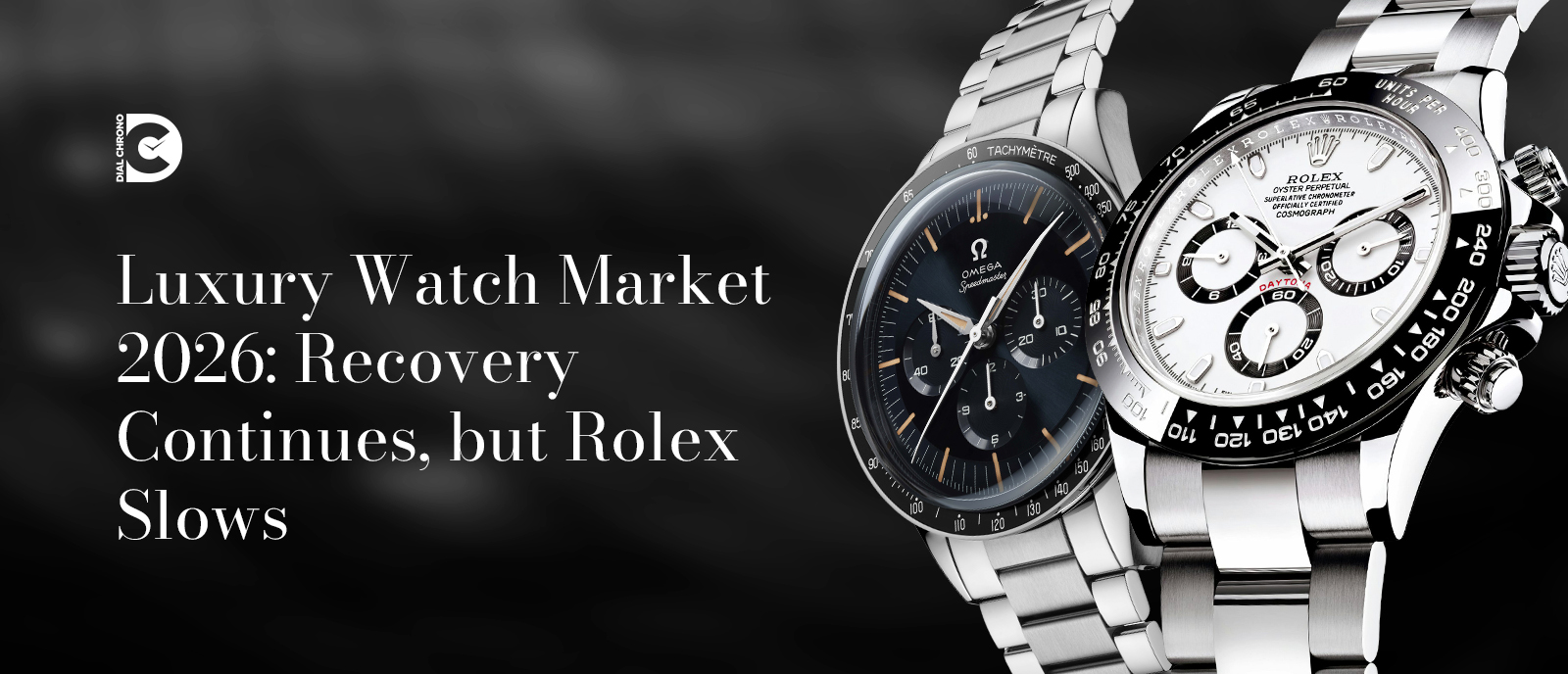
Heading into November, the luxury watch market 2026 is recovering, but unevenly: Swiss exports and resale prices are rising, while Rolex has slowed and used-watch inventories sit at records.
| Brand | Resale price change, 12 months to September 2026 |
|---|---|
| Vacheron Constantin | +17.7% |
| Patek Philippe | +17.0% |
| Cartier | +14.5% |
| Jaeger-LeCoultre | +11.0% |
| Rolex | +6.0% |
| Tudor | +2.4% |
| TAG Heuer | +2.3% |
| IWC | +1.4% |
| Breitling | 0.0% |
| Hublot | −5.5% |
Three October releases frame the luxury watch market 2026. First, on 20 October the Federation of the Swiss Watch Industry (FH) reported September exports of CHF 2.23 billion, up 11.7%, and CHF 19.5 billion over nine months, up 2.7% (Swissinfo/Bloomberg). Second, Morgan Stanley’s 13 October note, reported by Forbes, put third-quarter resale growth at 1.2%, with Rolex up only 0.5%. Finally, Chrono24’s Q3 report, published on 20 October, had Vacheron Constantin and Patek Philippe leading over twelve months (Esquire India).
To keep the picture clear, this luxury watch market 2026 analysis separates confirmed figures from estimates and interpretation, and flags where last year’s US tariff shock distorts comparisons. In short, it is analysis for readers, not investment advice. Data is as of 1 November 2026.
Table of Contents
Luxury watch market 2026: exports and the US tariff
Swiss exports are growing again, but September’s gain is flattered by last year’s tariff collapse and led by cheaper watches.
| Measure (FH data, as reported) | September 2026 | Context |
|---|---|---|
| Total exports | CHF 2.23 bn, +11.7% | Nine months: CHF 19.5 bn, +2.7% |
| United States | CHF 292.9 m, +85.7% | Base effect: September 2025 was CHF 158 m after the 39% tariff |
| France | CHF 247 m, +11.1% | Partly shipments in transit (see below) |
| Mainland China | −14.2% | Unusually strong month a year earlier |
| Export price above CHF 3,000 | +9.9% | Below the 11.7% average |
| Export price below CHF 500 | +39.5% | The CHF 200–500 band rose 52% |
Sources: Bluewin, Jing Daily, WWD via Yahoo and Frontaliere Ticino. However, FH figures measure shipments at export prices, not retail sales. Also, outlets differ on whether September was the fourth or fifth consecutive monthly rise.
Meanwhile, the middle of the market is thinning: in the first half, the CHF 500–3,000 band lost 5.7% in value (The Silent Luxury).
The US tariff on Swiss watches
Since 24 July 2026, the United States has charged a variable extra tariff of up to 12.5% on Swiss imports, with the existing most-favoured-nation (MFN) duty credited against it, so the combined rate is generally 12.5%. In effect, it replaced a 10% Section 122 surcharge that expired that day. Switzerland’s State Secretariat for Economic Affairs (SECO) notes that the new tariff has not been tested in court and that trade talks continue, so it could change (SECO). Before that, rates were 39% from August 2025, then a 15% ceiling from November 2025.
Retail prices
Retail prices in the luxury watch market 2026 also rose. For instance, WatchPro reported Rolex US list prices up about 7% on average from January, relayed by Gear Patrol on 22 December 2025, and later Reuters reported a further gold-watch increase in June (BNN Bloomberg). However, we have not verified these against Rolex’s own price lists.
Luxury watch market 2026 by brand: US, Europe and Switzerland
Across the luxury watch market 2026, FH reports exports by destination and price band, not by brand, so no official source shows how Omega is doing in Germany or Rolex in the United States. Still, company reports fill part of the gap. However, figures are group-level unless stated.
United States: the swing market
In fact, the biggest market is also the most volatile. Exports fell 14.8% in the first half, partly because of a very high 2025 base (JCK), then swung: July CHF 701.3 million (+26.5%), August CHF 197.5 million (−19.4%) and September CHF 292.9 million (+85.7%). In contrast, company signals are strong. For example, Swatch Group’s US sales rose 27% in the first half (Time+Watches). Likewise, Richemont’s Americas sales rose 27% in the quarter to 30 June, and its watch division’s 8% growth was led by the Americas and Japan (Richemont). Similarly, Watches of Switzerland’s US sales rose 24% in its year to 3 May and now exceed its UK sales (trading update).
Europe: strong headlines, murky data
Export data here, though, is murky. FH has described France as a logistics platform since December 2025, so some shipments counted as European are passing through to other markets (Bluewin). Therefore, treat France (+11.1% in September, +57% in May) and the European Union’s +15.5% with care. Instead, company reports are a better guide: Richemont’s Europe sales rose 11%, and Swatch Group, for example, reported Spain up 28% and Italy up 12% in the first half (Modaes). Meanwhile, the UK fell 5.2% in September after a strong August.
Switzerland: tourists and the franc
FH counts exports, so domestic sales are not in its figures, and we found no brand-level domestic data. However, the evidence is qualitative: Lucerne retailers reported fewer tourists in 2025 after the tariff threats and a strong franc (Tribune/Reuters), and Deloitte says the franc is eroding the VAT-refund appeal for tourists (Deloitte).
Find your brand
| Brand (owner) | Latest signal | Resale: Chrono24 Q3 / 12 months |
|---|---|---|
| Rolex | Est. CHF 11 bn turnover; no regional data. Retailer cites strong US demand | −0.2% / +6.0% |
| Omega (Swatch Group) | Est. CHF 2.2 bn, disputed by Swatch; own retail +20% in H1 | Not in sources read |
| Longines, Tissot (Swatch Group) | Double-digit H1 growth (group statement) | Not tracked |
| Cartier (Richemont) | Est. CHF 3.5 bn | +0.7% / +14.5% |
| Vacheron Constantin (Richemont) | Named among standout watch brands in the quarter | +6.7% / +17.7% |
| Jaeger-LeCoultre (Richemont) | Named among standout watch brands | +1.2% / +11.0% |
| IWC (Richemont) | Part of the same division | −0.2% / +1.4% |
| Audemars Piguet | Est. CHF 2.6 bn | +2.0% / up, figure not given |
| Patek Philippe | Est. CHF 2.5 bn | +3.0% / +17.0% |
| Tudor (Rolex SA) | No separate signal found | −1.3% / +2.4% |
| TAG Heuer (LVMH) | Retailer cites strong US demand | −3.0% / +2.3% |
| Hublot (LVMH) | LVMH watches and jewelry +6% organic in Q3, jewelry-led | −4.5% / −5.5% |
| Breitling | No separate signal found | −3.4% / 0.0% |
Also, turnover figures are Morgan Stanley × LuxeConsult estimates for 2025, not company-reported (The Peak). In addition, resale figures come from Esquire India and The Hour Markers, which reproduces Chrono24’s table. Chrono24’s index spans 13 brands. Omega’s figures were not in the reports we read, and Longines and Tissot are not among the brands it tracks.
Luxury watch market 2026 on resale: prices up, supply up faster
Within the luxury watch market 2026, resale prices rose 1.2% in Q3 on WatchCharts’ measure and 8.3% over a year, but remain about 29% below their April 2022 peak (Forbes). Likewise, Chrono24’s index rose 0.7% in the quarter and 7.5% over twelve months. However, the two differ: WatchCharts tracks 300 watches from 10 brands, weighted by value, while Chrono24 covers more than 140 references on its own marketplace.
Still, momentum and value retention are different things. Morgan Stanley’s data compares resale prices with retail prices for current watches:
| Brand | Resale vs retail, Q3 2026 |
|---|---|
| Patek Philippe | +16.3% |
| Rolex | +10.3% |
| Audemars Piguet | +5.9% |
| Cartier | −25.9% |
| IWC | −41.2% |
In addition, per Forbes, every other brand Morgan Stanley tracks trades at least 25% below retail. Cartier and Vacheron Constantin are rising fast on resale yet still sit well below boutique prices.
However, supply is the warning sign. For the six brands Morgan Stanley studies in depth, listed inventory rose 5.7% in the quarter and 19.3% in a year, a record for all six, and Rolex’s absorption rate (the share of inventory that sells in a period) also fell to its lowest since Q3 2024. Also, listings are asking prices, not completed sales.
Auctions: Geneva’s week starts on 7 November
Auctions are a read on the top end of the luxury watch market 2026. Overall, Phillips says its spring sales in Geneva, Hong Kong and New York realised more than US$235 million, with three watches above US$10 million (Haute Time). One-off consignments drive such totals, so treat them as a read on trophy pieces. Also, estimates below exclude the buyer’s premium.
| Date | Sale | Notable lot |
|---|---|---|
| 7–8 Nov | Phillips, Geneva XXIV | Patek Philippe Ref. 1436 in steel, 1945: CHF 2–4 million |
| 7–8 Nov | Antiquorum, Geneva | F.P. Journe lot: CHF 400,000–800,000 |
| 8–9 Nov | Sotheby’s, Geneva | Unique A. Lange & Söhne clock watch, c. 1914: CHF 500,000–1 million |
| 9 Nov | Christie’s, Geneva | Patek Philippe Ref. 1518, 1948: CHF 500,000–1 million; Michael Schumacher’s F.P. Journe watches |
| 21–22 Nov | Phillips, Hong Kong XXIII | Patek Philippe Ref. 2499 First Series: HK$12–24 million |
Sources: Haute Time, Phillips and Antiquorum. In addition, Phillips warns that buyers of non-US-origin watches may owe US import tariffs.
Industry moves
Several company reports shaped the luxury watch market 2026 this autumn:
- Richemont. Sales for the quarter to 30 June rose 20% at constant exchange rates to €6.3 billion. In particular, Specialist Watchmakers grew 8% to €873 million. Next, interim results are due on 13 November (Richemont).
- Swatch Group. Meanwhile, first-half sales were CHF 3.121 billion, up 8.5% at constant rates but 2% at current rates because of the strong franc (Modaes).
- LVMH. Watches & Jewelry made €2.5 billion in Q3, up 6% organically, led by jewelry, so it is not a clean read on watches (National Jeweler).
- Ebel. On 8 October, Movado signed a binding agreement to sell 95% of Ebel for US$66.5 million to a group led by Montres Journe (maker of F.P. Journe), with Chanel and executive Pierre Jacques. However, it remains subject to closing conditions (National Jeweler).
- Rolex and Bucherer. WatchPro counts 13 Rolex boutique openings in 2026, seven run by Rolex-owned Bucherer, and argues this contradicts a 2025 statement that Rolex did not intend to grow Bucherer (WatchPro, 27 October). However, that is WatchPro’s analysis.
What the luxury watch market 2026 means for collectors
Overall, the data rewards specific brands and references, not the category as a whole.
- Retail price does not predict resale value. Only Patek Philippe, Rolex and Audemars Piguet trade above list on average. In other words, that says something about pricing, not quality.
- Rolex is cooling at the margin, not collapsing. For instance, it is up 6.0% over twelve months on Chrono24 and about 10.3% above retail. But record listings and the weakest absorption since late 2024 mean sellers may wait longer and buyers may negotiate more. However, that is our reading, not a reported finding.
- Momentum has moved to high horology. Vacheron Constantin and Patek Philippe lead Chrono24’s twelve-month ranking, and A. Lange & Söhne posted the biggest quarterly gain on WatchCharts (+4.4%). Chrono24 also singles out the Jaeger-LeCoultre Reverso, with square cases making up four of the year’s ten best performers.
- Independents have buzz but little tracked data. Forbes notes that most independents’ prices are not covered by the indices, so makers such as MB&F, whose HM12 The Guardian we covered recently, generally sit outside them. Record F.P. Journe auction results are real but cover a handful of rare pieces.
However, none of this is a forecast or a promise of appreciation. After all, a rising index says little about any single watch.
Limits of the luxury watch market 2026 data
- Indices differ. WatchCharts shows +1.2% for the quarter and Chrono24 +0.7%. Rolex is over half of the WatchCharts index, so its slowdown weighs heavily.
- Exports are not consumer demand. Because FH counts shipments at export prices, transit through France blurs the European picture.
- The tariff can move. SECO says it has not been tested in court, so the rate may change.
- Rankings are estimates. Morgan Stanley × LuxeConsult figures are modelled, while Swatch Group disputes its Omega numbers.
- Group results also blend categories, such as watches with jewelry.
- Some sources have a stake. Auction houses promote their own sales, and some resale commentary comes from pre-owned dealers.
Conclusion: the luxury watch market 2026 is healing, not booming
In the end, the luxury watch market 2026 is healing, but the recovery is narrower than the headlines suggest. Resale prices have gained for five straight quarters, and Swiss exports are 2.7% higher after nine months. Yet Rolex has plateaued under record supply, Vacheron Constantin and Patek Philippe set the pace, export growth sits at the cheap end, and the US comparison is still distorted by last year’s tariffs.
Looking ahead, the next data points for the luxury watch market 2026 are Geneva’s auctions (7–9 November), Richemont’s interim results (13 November), FH’s October exports (listed for 19 November) and Phillips Hong Kong (21–22 November).
Frequently asked questions
Is the luxury watch market 2026 recovering?
Yes, but unevenly. Swiss exports are up 2.7% over nine months and resale prices have gained for five straight quarters. Still, Rolex has slowed and used-watch inventories are at records.
Are luxury watch prices rising in 2026?
In the luxury watch market 2026, resale prices are up, though only modestly: WatchCharts shows +8.3% over a year and Chrono24 +7.5%. However, individual brands vary widely, and Cartier and IWC trade well below retail.
What US tariff applies to Swiss watches now?
Since 24 July 2026, a combined rate of generally 12.5%, according to SECO. It has changed several times since 2025, so confirm it for a specific import.
Is Rolex losing value?
Not on this data. In the luxury watch market 2026, Rolex is up 6.0% over twelve months on Chrono24 and about 10.3% above retail, but momentum has slowed under record supply.
How we compiled this
This luxury watch market 2026 update is desk research based on published reports, company filings and official pages, checked on 1 November 2026. Also, we did not test any watch. Figures are as published by each source, and market data changes, so check the sources before relying on a number. Finally, Dial Chrono is an editorial publication and does not sell watches.
